
SCHOLARSHIPS | ARBOR SCHOOL DUBAI
Scholarships
In this Section
-
QUICK LINKS
-
 Book a Tour
-
 Ecological Approach
-
 Fees
Fees
ARBOR SCHOLARSHIP PROGRAMME
At Arbor School, we recognise that excellence takes many forms.
Our KHDA-approved scholarship programme celebrates students who demonstrate exceptional ability, commitment and potential across Academics, Sport, the Arts and through the Arborist Scholarship, for students with a genuine passion for environmental leadership.
Whether recognising the achievements of existing students or welcoming exceptional new talent into our community, our scholarships are designed to recognise potential, reward dedication and support students in continuing to develop their strengths.
Scholarship awards of up to 75% of annual tuition fees are available, subject to the individual scholarship criteria.
The Arborist Scholarship
The Arborist Scholarship is open to prospective Primary and Secondary students who demonstrate a genuine passion for environmental or ecological issues.
Rather than focusing solely on academic achievement, it celebrates students who show initiative, environmental awareness and the potential to make a meaningful contribution to their communities and the world around them.
Scholarship awards of up to 25% of annual tuition fees are available.
Ready to take the next step?
Download our Scholarship Candidate Pack below to learn more about each scholarship, or apply online for the Arborist Scholarship today.
Apply for the Arborist Scholarship
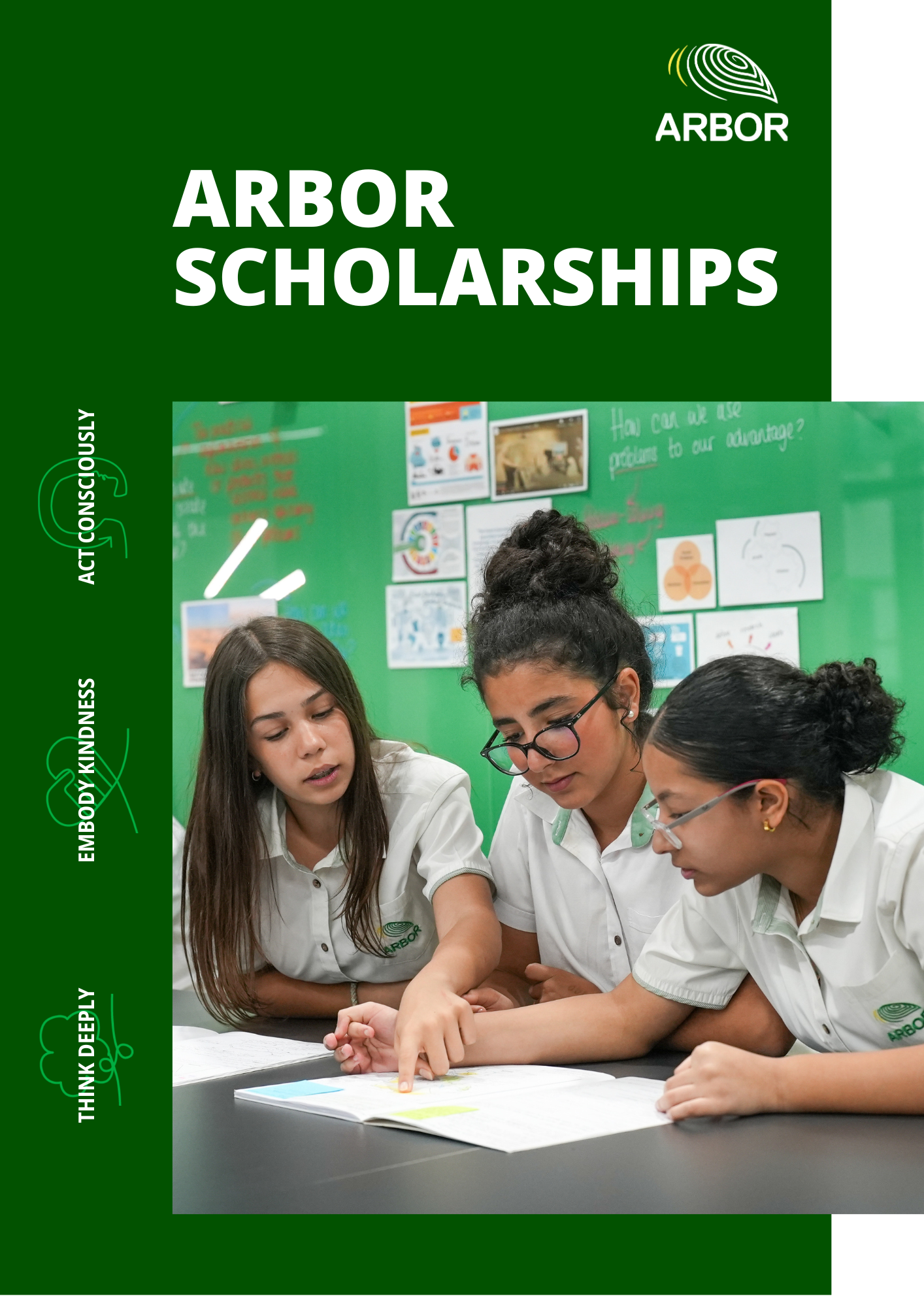
Scholarship Criteria: Arbor School
In line with Arbor capabilities the scholarship applicant should show a range of the aspects detailed below:
Students should have some of the following listed below:
CAT4 Score:
Candidates should achieve a CAT4 score of 128 or above, demonstrating strong cognitive abilities across the key areas of verbal, non-verbal, quantitative, and spatial reasoning.
And/or PT Assessments:
Candidates should have achieved scores of 8 or 9 in their PT assessments, showcasing their consistent high performance across subjects.
And School Report:
Candidates must have a strong school report across all subjects. This includes not only high academic achievement but also consistent effort, participation, and a positive attitude towards learning. Reports should reflect a well-rounded scholar who excels in various disciplines. They should have above 94% attendance/punctuality.
Show critical thinking and systems level thinking in their discussions and work.
Students should demonstrate emotional understanding both for themselves and in a socio-emotional context in a number of ways:
- Self awareness and ability to self reflect
- Empathetic understanding of others
- Promote a positive social environment
- Responsible decision making which balances the needs of others
- Build and maintain healthy relationships with others
- Communicate and collaborate effectively
- Confidence to seek support when needed
Students should actively engage in activities beyond the classroom that reflect their interests and passions. These activities may include, but are not limited to:
- Service-based initiatives – volunteering to support others or contribute to environmental conservation efforts.
- Environmental stewardship – caring for animals, participating in conservation projects, or engaging in sustainability practices.
- Scientific exploration – undertaking projects aimed at improving the world through discovery and innovation.
- Debate and public speaking – exploring Sustainable Development Goals (SDGs) and ethical mindsets through discourse and advocacy.
- Fieldwork in environmental science – conducting hands-on research and exploration of ecological systems.
- Leadership and global awareness – taking on leadership roles in projects such as Model United Nations (MUN).
- Mathematical inquiry – exploring mathematical concepts and engaging in projects that push the boundaries of mathematical understanding
Students should demonstrate a profound connection to the world around them.
This connection can be evidenced in various ways, reflecting how they engage with others and the environment through their actions and choices. They show deep connection with:
- social responsibility and their desire to make a positive impact on their community.
- contributing positively to the school community. This could be through initiating or leading projects, mentoring peers, or actively participating in school events.
- preserving the natural world and understanding their role in environmental conservation
- global challenges and a desire to contribute to a better world.
- scientific discovery and improving the quality of life for others
- ethical principles and their drive to inspire change in their communities
- the power of STEM in understanding and improving the world
- artistic endeavours and appreciation of beauty
- cultural differences and a desire to foster a more inclusive society
THE ARBOR SCHOLARSHIP MONITORING SYSTEM
All scholars are assessed every term with regards to the four areas listed below. Student feedback is given in their one-to-one meeting with either the Head of Secondary (Ms Powell) or Futures Counsellor (Ms Sherifa). If there is an issue or concern then a parent meeting is held and specific targets given. Students meet bi-weekly with attendance, engagement and participation being monitored.
Student performance is assessed every term through:
- The Scholar Support Plan which is completed every half term by scholars and teachers
- ‘Round-robin’ style feedback from classroom teachers
- A day in the life – shadowing a scholar for a day
- Attendance to all scholar meetings, as well as general school attendance
- Mentor feedback – form completion
- Initiatives, committees and groups they participate in – attendance and engagement
- School report and data drops
- CAT 4, NGRT and GL data
- Awards internally or externally e.g. Maths Olympiad, Emirates Lit Festival
- Arbor Extend Programme – Engineering BTEC, Further Maths, Additional GCSE/A Levels
In line with Arbor capabilities the scholar is monitored in the following areas detailed below:
CAT4 Score
NGRT Scores
PT Assessments
School Report and data drops
External/Internal Awards
Arbor Extend Programme (Yr10+)
Student reflections in Support Plan
Round Robin feedback
Mentor Feedback
A day in the life observations
Feedback on attendance and participation in:
Service projects, environmental projects, science projects, fieldwork, MUN, engineering work, councils and committees
Student and staff reflections on their engagement in social responsibility projects, positive contribution to the school community, environmental conservation projects.


