SECONDARY CURRICULUM
Learning at Arbor
In this Section
From Year 7 to Year 13, students develop increasingly specialised subject knowledge, progressing from a broad Key Stage 3 curriculum to personalised GCSE, IGCSE, A Level and vocational pathways.
The Secondary curriculum at Arbor combines specialist subject teaching with Ecoliteracy and interdisciplinary learning.
As students progress from Year 7 to Year 13, they develop greater depth of knowledge and increasing independence. Specialist teachers provide academic challenge across all subjects, while individual guidance helps students select qualifications and experiences aligned with their strengths, interests and future plans.
Alongside their subject curricula, students have opportunities to apply knowledge through interdisciplinary projects, research, service and action. This allows them to examine local and global issues from different perspectives and consider how knowledge from different disciplines can inform their understanding and response.
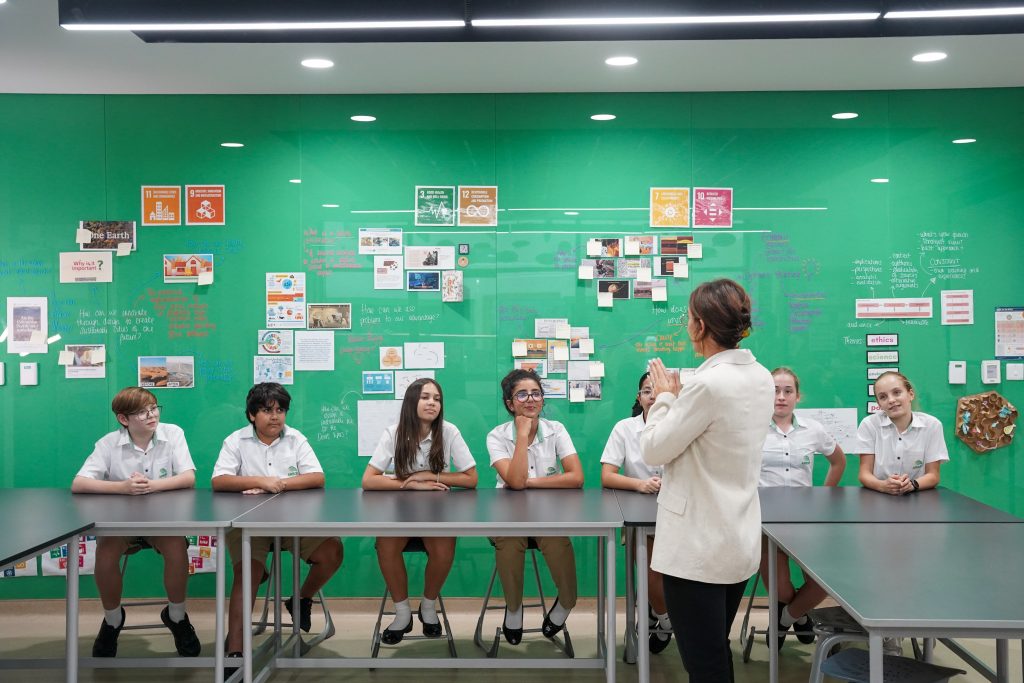
The Secondary learning journey
Key Stage 3 establishes broad academic foundations and prepares students for the greater independence and specialisation of Key Stage 4.
Students study a wide range of academic, creative, technical and physical subjects taught by specialist teachers. They learn to manage different subjects and expectations, organise their work and take increasing responsibility for their progress.
The curriculum develops:
- Secure subject knowledge
- Critical and analytical thinking
- Research and inquiry skills
- Communication and collaboration
- Creativity and problem-solving
- Organisation and independent learning
- Global awareness and environmental responsibility
Alongside their subject curricula, students complete Arbor’s Community Impact Certificate, connecting interdisciplinary learning with inquiry, service and community engagement.
Key Stage 3 Subjects
Subjects include:
- English
- Mathematics
- Science
- Arabic
- Islamic Education for Muslim students
- Moral, Social and Cultural Education
- Ecoliteracy and concept-based learning
- Geography
- History
- French or Spanish
- Art and Design
- Design Technology and Food Technology
- Music and Performing Arts
- Computing and Digital Technology
- Physical Education
Families can access year-specific curriculum overviews for further information about the concepts, knowledge and skills taught within each subject.
At Key Stage 4, students follow personalised GCSE, IGCSE and vocational pathways based on their interests, strengths and future plans.
English, mathematics and science remain at the centre of each student’s programme. Students then select three or four additional subjects from the available options, supported by guidance from teachers, pastoral leaders and the Futures Counselling team.
Students increasingly focus on:
- Developing detailed subject knowledge
- Applying knowledge to unfamiliar questions
- Analysing evidence and constructing arguments
- Working independently
- Responding to assessment and feedback
- Developing revision and examination skills
- Preparing for appropriate post-16 pathways
Physical Education, Moral, Social and Cultural Education and wellbeing remain part of the Key Stage 4 programme.
Key Stage 4 Subjects
Core Curriculum
All students will study the following compulsory subjects:
| Core
Subjects |
Arbor
Curriculum |
KHDA |
|---|---|---|
| English Language | Global Perspectives GCSE | Arabic (Native/Non-native) |
| English Literature | Moral Education | |
| Mathematics (H/F Tier) | UAE Social Studies | |
| Science (Double/Triple) | Islamic Studies (Muslim students only) |
Additional Option Subjects
Students are required to select any three subjects from the list below, one from each option block:
| Block A | Block B | Block C |
|---|---|---|
| Art & Design GCSE | Economics iGCSE | Design Technology GCSE |
| Business Studies iGCSE | Spanish iGCSE | History iGCSE |
| Design Technology GCSE | Geography iGCSE | Psychology GCSE |
| Separate Sciences iGCSE | Physical Education GCSE | |
| French iGCSE | ||
| Vocational Options | ||
| BTEC International Level 2 Business | Level 2 NCFE Food & Cookery | BTEC International Level 2 Information Technology |
Arbor Sixth Form provides personalised academic and vocational pathways for students preparing for university, further study and employment.
Students typically specialise in three or four subjects, developing advanced subject knowledge alongside the analytical, research and independent-study skills required for post-18 progression.
The Sixth Form experience includes:
- A Level and vocational pathways
- Specialist subject teaching
- Personalised academic guidance
- Dedicated pastoral support
- University and careers counselling
- Leadership and community engagement
- Work experience
- The Branching Out Programme
- The Global Impact Certificate
- The opportunity to complete an Extended Project Qualification
Subjects offered at Key Stage 5 include:
| Option A | Option B | Option C | Option D |
|---|---|---|---|
| Mathematics A Level | Physics A Level | Chemistry A Level | Psychology A Level |
| Global Perspectives & Research A Level | Art & Design A Level | Business A Level | Design Technology A Level |
| Sociology A Level | Biology A Level | French A Level | Economics A Level |
| Spanish A Level | History A Level | Geography A Level | English Literature A Level |
| Vocational Options | |||
| Sport Level 3 BTEC Sub Diploma | Business Level 3 BTEC Sub Diploma | Hospitality Level 3 BTEC Sub Diploma |
All Key Stage 3 students work towards Arbor’s Community Impact Certificate.
The programme combines three core elements:
- The Concept Curriculum
- Termly showcase events
- Service Learning and Action Exhibition
Through interdisciplinary inquiry, students examine significant ideas from ecological perspectives and through questions that connect with their communities. They develop relevant knowledge across different subjects, undertake research and fieldwork, and consider possible responses.
Through the programme, students develop capabilities including:
- Critical Thinking
- Systems Thinking
- Futures Thinking
- Strategic Thinking
- Eco-centric Thinking
- Perspective Taking
- Equity and Justice
- Leadership
- Collaboration
- Adaptability
- Innovation
- Influence
Termly showcases and exhibitions give students opportunities to present and explain their work to others.
The Global Impact Certificate develops global citizenship, Ecoliteracy and action across Key Stages 4 and 5.
Level 1: Key Stage 4
All Key Stage 4 students complete Level 1 during curriculum time.
The programme focuses on Passion, Purpose and Perception, combining service learning, enterprise, recreation, academic learning and the arts through student-led sustainability projects.
Its core components are:
- Global Perspectives IGCSE
- Arbor Action and Service
- Presentations and exhibitions
Level 2: Key Stage 5
Level 2 is aligned with the United Nations Sustainable Development Goals and competencies for education for sustainable development.
Through Arbor’s Branching Out Programme, students select experiences aligned with their interests, strengths and future plans. They also complete a service-learning project, compile an evidence portfolio and reflect on their leadership, development and contribution to the community.
Core components include:
- Branching Out pathways
- A service-learning project
- An evidence portfolio
- A viva voce presentation
Level 3: Extended Project Qualification
Students may also choose to undertake an Extended Project Qualification (EPQ).
Working independently with the support of a supervisor, students investigate a topic of their choice and produce one of four project types:
- A dissertation
- An investigation
- A performance
- An artefact
The EPQ develops advanced research, critical thinking, project management, reflection and academic writing skills.
Ecoliteracy enables students to examine relationships between ecological, social and economic systems and consider their own place within them.
Across Secondary, students examine biodiversity, climate justice, resilience, sustainable development and changing economic systems. These areas are addressed through subject teaching, concept-based learning, Global Perspectives, service projects and independent research.
Ecoliteracy does not sit separately from the academic curriculum. It provides contexts in which students can draw on disciplinary knowledge: a scientific question may also involve ethical, economic or geographical considerations, while a service project may require research, communication, collaboration and evaluation.
As students progress through Secondary, they work with increasing complexity, evaluate evidence and distinguish between different perspectives before developing informed responses.
Critical thinking, systems thinking, futures thinking and strategic thinking are developed throughout the Secondary curriculum.
Students learn to ask productive questions, locate and evaluate information, construct arguments and communicate evidence-based conclusions. Teachers use different teaching methods according to the subject, content and needs of their students, while ensuring that independent thinking is grounded in secure knowledge.
Students progressively develop their ability to:
- Examine complex questions
- Make connections between concepts
- Research independently
- Evaluate the reliability of evidence
- Recognise assumptions and differing perspectives
- Apply knowledge in unfamiliar contexts
- Justify decisions
- Reflect on and refine their work
These skills support students as academic demands increase through GCSE, IGCSE, A Level and vocational study.
Students are taught by specialist teachers across the Secondary curriculum, giving them access to subject expertise, specialist resources and facilities appropriate to each discipline.
Learning environments include:
- Science laboratories and the Secondary Biolab
- Biodomes and wider living-campus spaces
- Design and Technology facilities
- Food Technology facilities
- Art studios
- IT and computing spaces
- Music technology and recording studios
- Library
- Sports and performance facilities
- Seminar rooms and flexible learning spaces
- Dedicated Sixth Form study areas
These spaces support practical work, creative production, collaborative work and independent study.
Home learning reinforces classroom teaching while supporting students to develop organisation, independence and effective study habits.
Key Stage 3
English, mathematics, science, Arabic, French and Spanish set weekly home learning according to an established schedule. Individual tasks should generally take approximately 20–30 minutes.
Students can also complete activities connected to the termly Concept Curriculum. These may involve independent research, reflection or creative work across subjects including history, geography, Physical Education, Art, Design Technology, Performing Arts, Computing and Digital Technology.
Key Stages 4 and 5
As students progress towards public examinations and further study, expectations for independent learning increase.
Tasks may include:
- Online assignments
- Exam-style questions
- Extended writing
- Revision and retrieval practice
- Independent research
- Pre-reading
- Coursework and project development
Home learning is adapted where appropriate to support individual needs while maintaining suitable academic expectations.
Assessment is used to understand students’ attainment, monitor progress and identify appropriate next steps.
Teachers draw on a range of evidence, which may include:
- Classroom work and discussion
- Home learning and independent study
- Practical activities
- Projects, presentations and exhibitions
- Formal assessments
- Mock and public examinations
- Students’ attitude to learning
- Teachers’ professional judgement
Students receive feedback to help them understand their strengths, address misconceptions and improve their work.
Families receive a report each term:
- Term 1: Includes SMART targets
- Term 2: Provides a data-focused progress update
- Term 3: Includes a written narrative
Reports include information about attainment, attitude to learning, attendance and punctuality, together with recommendations for further development. Parent-Teacher Conferences provide opportunities to discuss academic progress, wellbeing and next steps.
Students receive guidance as they progress through Secondary and make decisions about subjects, qualifications and post-school pathways.
Support includes:
- Individual and group counselling
- GCSE and post-16 subject-selection guidance
- Personalised academic and career planning
- University and apprenticeship guidance
- Digital portfolios through Unifrog
- University fairs, visits and application workshops
- Guest speakers and industry professionals
- Parent workshops and webinars
- Work experience for Sixth Form students
- Resources related to students’ individual interests
Arbor’s Futures Counselling provision helps students understand the options available to them and plan pathways aligned with their abilities, interests and ambitions.
Students meet their Form Tutor each morning and participate in a dedicated weekly tutor session.
The pastoral curriculum includes:
- Emotional awareness and resilience
- Relationships, empathy and communication
- Decision-making and problem-solving
- Digital wellbeing
- Values and ethics
- Relationship and Social Health Education
- Positive Education
Positive Education draws on positive psychology to help students recognise their strengths, develop constructive habits and build strategies to support their wellbeing.
This is supported by a wider pastoral network including Form Tutors, Heads of Year, counsellors, inclusion specialists and senior leaders.
Moral, Social and Cultural Education addresses:
- Character and morality
- Individual and community
- Civic studies
- Cultural studies
Students study ethics, citizenship, identity, heritage and global issues. They consider different perspectives, examine their responsibilities and develop their understanding of the communities in which they live.
Islamic values form an important part of the UAE’s educational and cultural context. Muslim students receive Islamic Education in accordance with national requirements, while the wider school culture reflects principles including respect, compassion, honesty, integrity, humility and social responsibility.
The Thrive Team works alongside teachers, pastoral leaders, students and families to support a range of educational and wellbeing needs.
Support may include:
- Classroom adaptations
- Targeted academic intervention
- English-language support
- Individual learning strategies
- Alternative provision where appropriate
- Counselling and wellbeing support
- Extension for Accomplished Learners
- Support for Students of Determination
Provision is designed to give students access to an ambitious curriculum, with the support and adaptations appropriate to their individual needs.
The Arbor Enrichment Experience gives students access to activities alongside their timetabled lessons.
Its seven strands encompass academic inquiry, competition, outdoor activities, creativity, performance, leadership, service and enterprise.
Activities take place before school, during lunchtime and after school. Students may also participate in competitions, events, student councils, leadership groups, curriculum-linked visits and residential experiences.
Day trips may include museums, cultural institutions, natural environments, businesses and community organisations. Residential experiences provide opportunities for students to develop independence and teamwork through activities, service and study away from the school site.
Explore Secondary at Arbor
Visit Arbor to discover how specialist teaching, academic rigour, ecoliteracy, personalised pathways and meaningful action come together throughout the Secondary years.
Partners and Accreditations