
Foundation stage CURRICULUM
Learning at Arbor
In this Section
Our Foundation Stage curriculum combines the Early Years Foundation Stage framework with Ecoliteracy, project learning, focused teaching and play.
Children learn through a combination of play, focused teaching, guided activities and independent investigation. Teachers plan and adapt the learning environment to support each child’s development across all seven areas of the Early Years Foundation Stage (EYFS) framework.
Each term, children take part in a project that brings together Ecoliteracy and the EYFS curriculum around a driving question. Discussions, stories, investigations and first-hand experiences help children develop knowledge and apply what they have learned in different contexts.
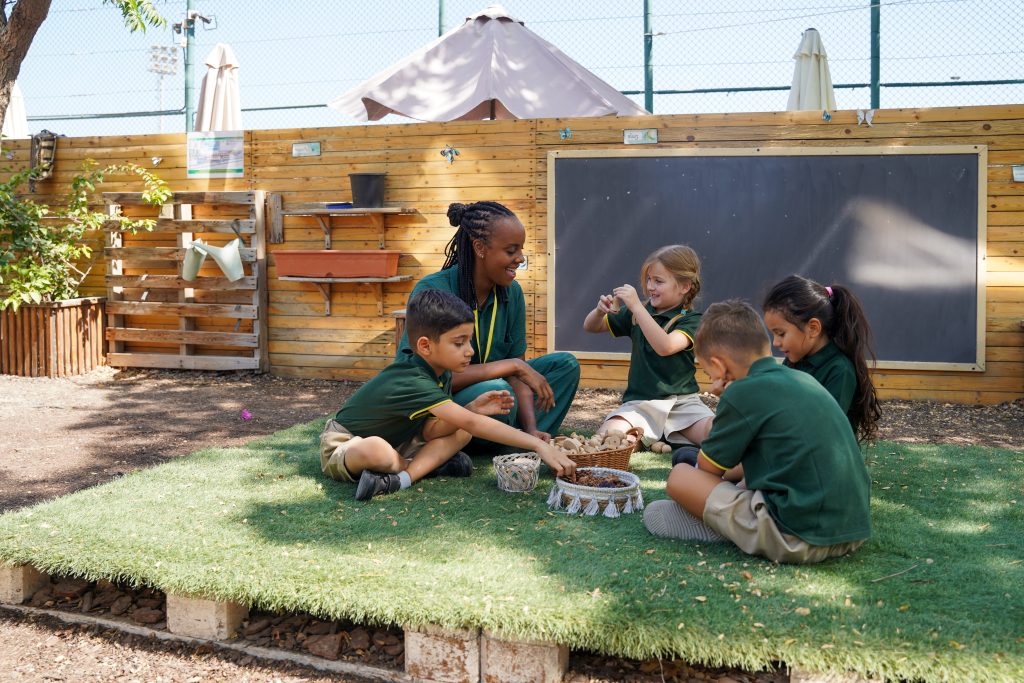
The Foundation Stage curriculum encompasses seven interconnected areas of learning and development.
The Prime Areas
- Communication and language
- Physical development
- Personal, social and emotional development
The Specific Areas
- Literacy
- Mathematics
- Understanding the world
- Expressive arts and design
The prime areas provide the foundations for children’s wider development. As children move through FS1 and FS2, they have increasingly focused opportunities to develop reading, early writing and mathematical understanding while continuing to make progress across the full framework.
Each area is represented throughout the learning environment, from role play and construction to investigation, making and outdoor learning. This gives children opportunities to encounter ideas in different contexts and revisit what they have learned through play.
Each Foundation Stage project follows a sequence that introduces a driving question, develops children’s knowledge and thinking, and gives them an opportunity to share what they have learned.
Launch
Each project begins with an experience that introduces the driving question and starts discussion.
Discovery Time
For much of the day, children learn through play across indoor and outdoor environments. They make choices, investigate ideas and pursue their interests.
Focused Teaching
Alongside Discovery Time, children participate in focused teaching in phonics, mathematics and project learning.
Responsive Learning
Teachers observe children’s interests, ideas and development. These observations inform how they adapt the environment, their interactions and subsequent teaching.
Landing
Each project concludes with an opportunity for children to share what they have learned with others.
Discovery Time is a planned part of the Foundation Stage day during which children use the learning environment, make choices and develop their ideas through play.
Teachers observe, question, model language and introduce ideas that develop children’s thinking. Their knowledge of each child enables them to identify appropriate next steps and respond to individual interests and stages of development.
During Discovery Time, children communicate ideas, solve problems, test possibilities, work with others and develop their ability to sustain attention. Activities are connected wherever possible to situations children recognise, helping them apply knowledge and skills in different contexts.
Ecoliteracy helps children begin to recognise the relationships between people, communities and natural systems.
Children encounter these ideas directly by observing plants and animals, investigating habitats, growing food, working with natural materials and caring for shared environments.
Arbor’s biodomes, Biofarm and outdoor learning areas provide different settings for observation and investigation throughout the year.
Woodtopia
Woodtopia is Arbor’s Foundation Stage woodwork programme. With close adult guidance, children learn to use real tools safely as they design, make and adapt their creations.
Woodwork provides a practical setting for developing coordination, concentration and problem-solving. It also introduces mathematical concepts involving shape, space and measurement.
Muddy Madness
Muddy Madness takes place in the Learning Garden and gives children regular opportunities for sensory play and outdoor investigation.
As they dig, mix, pour, build and experiment, children work with different textures, quantities and materials. These activities support physical development, language, collaboration and imaginative play.
Learning Across Arbor’s Living Campus
The biodomes, Biofarm and outdoor learning environments form part of Foundation Stage learning throughout the year.
Children use these spaces to encounter living things, food systems, changing environments and natural materials first-hand, providing practical contexts for different areas of the curriculum.
Beginning in FS2, Arabic forms part of children’s everyday classroom experience.
Children hear, see and use Arabic through:
- Daily routines and greetings
- Songs, rhymes and stories
- Play and inquiry-based experiences
- Classroom displays and learning environments
- Vocabulary connected to current projects and class texts
Each FS2 class works with an Arabic Teacher or Learning Support Assistant alongside the class teacher. Together, they help children develop confidence in using Arabic and their knowledge of the culture, heritage and traditions of the UAE.
Key vocabulary, phrases, songs and rhymes are also shared with families through Seesaw and curriculum communications.
Classrooms open at 7:45am, allowing children time to settle before registration begins at 8:00am.
Throughout the day, children move between Discovery Time, focused teaching and responsive learning. Focused sessions include phonics, mathematics and project learning, alongside time for play across indoor and outdoor environments.
Children also have specialist provision including Arabic, Islamic Education for Muslim children, Ecoliteracy, Creative Arts, library, Physical Education and swimming. Swimming begins in Term 2 for FS1 children.
Children have a snack and lunch each day. Families may provide food from home, order through The Farmhouse or combine both options. The Farmhouse uses fresh ingredients and school-grown produce to provide healthy and nutritious meal options.
The Foundation Stage school day finishes at 1:30pm from Monday to Thursday and 11:30am on Friday.
Reading is the principal focus for home learning in Foundation Stage.
Children choose a library book each week to share with their family. Once they begin phonics, they also receive a reading book matched to their reading stage, supporting decoding, fluency and early reading development.
Families are encouraged to read together regularly and make books, stories and conversation part of their daily routine.
Assessment takes place throughout children’s daily learning and is informed by:
- The objectives of the EYFS framework
- Each child’s individual age and stage of development
- Observation during play, investigation and everyday experiences
- Independent application of knowledge and skills
- Teachers’ professional knowledge and judgement
Families receive weekly updates through Seesaw. More formal opportunities to discuss progress include phonics and reading reports, Week to Shine stay-and-play sessions and Parent Teacher Conferences.
Foundation Stage children are introduced to seven learning skills adapted from Arbor’s Ecoliteracy curriculum:
- Exploring Eagle: You enjoy exploring new things.
- Communicating Crocodile: You share your ideas and listen to others.
- Responsible Rhino: You think before you act and make positive choices.
- Inquiring Iguana: You ask questions and enjoy finding out more.
- Collaborative Crab: You work with others to complete tasks and achieve shared goals.
- Creative Caterpillar: You use your imagination when you play, make and solve problems.
- Thinking Thresher: You make connections and deepen your understanding.
These characters give children accessible language for recognising and describing the different approaches they use when learning.
Every child develops at a different pace and brings their own strengths, interests and needs to school.
Where additional support, intervention or challenge is appropriate, the Thrive Team works with families and teachers to identify suitable provision. This may include support for Students of Determination, extension for highly able learners, English-language support, individual transition arrangements or targeted interventions.
Seedling Club provides supervised after-school care from 1:30pm-4:20pm, Monday to Thursday.
Children can take part in games and activities and spend time with their peers at the end of the school day.
Additional after-school activities are available throughout the year. Programmes, availability, timings and fees are shared with families.
Visit Foundation Stage at Arbor
Visit our Foundation Stage environments, meet members of the team and see how children learn throughout the school day.


